
Home Automation - wellness centric lighting Control
The Invisible Healer: How Wellness-Centric Lighting Control Transforms Modern Spaces
In modern interior design, light is no longer treated as a mere utility. It has evolved into a vital element of health and architecture, giving rise to wellness-centric lighting control. By combining the biological science of circadian rhythms with the aesthetic minimalism of invisible technology, modern spaces can now support our well-being without cluttering our visual landscape.
Here is a guide to planning a lighting ecosystem that prioritizes human health while maintaining a flawless, minimalist design.
1. The Core: Circadian Lighting & Human-Centric Design
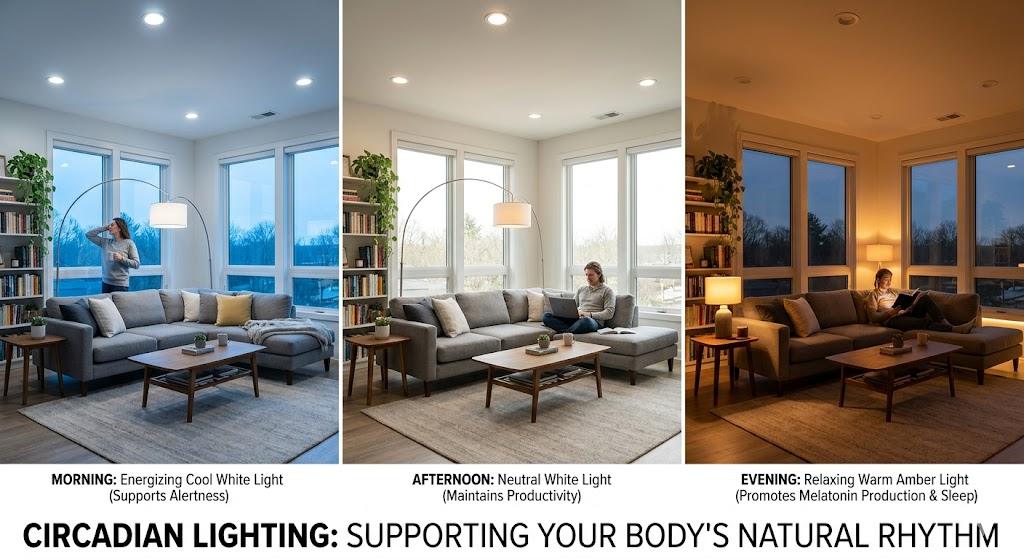
At the heart of wellness lighting is the concept of circadian tuning—mimicking the natural progression of the sun to regulate our biological clocks.
Our bodies rely on light cues to produce cortisol (for alertness) and melatonin (for sleep). Standard, static indoor lighting disrupts this rhythm. Wellness-centric automation fixes this by dynamically shifting two key elements throughout the day:
- Color Temperature: Moving seamlessly from a warm, amber glow ($2500\text{K}$) in the early morning to a crisp, blue-enriched white (5000k} - 6500k) at midday to boost productivity, and gradually rolling back down to a soft white (2700K or lower) in the evening.
- Intensity & Flicker-Free Dimming: Implementing high-quality phase-cut or digital protocols like DALI ensures that light levels drop smoothly without micro-flickers, which are known to cause eye strain and headaches.
The Daily Circadian Cycle
| Time of Day | Light Scene | Color Temp | Biological Effect |
| Morning | Energize / Wake Up | 3000k - 4000k | Suppresses melatonin; gently promotes alertness. |
| Midday | High Focus | 5000k- 6500k | Mimics peak daylight; maximizes cognitive performance. |
| Evening | Wind Down | 2700k | Signals the body to prepare for rest. |
| Night | Nightpath / Rest | $2200k - 2500k | Zero blue-light disruption; provides safe navigation. |
2. The Philosophy: Invisible Technology
True luxury lies in performance, not presence. Invisible technology ensures that the sophisticated hardware driving your wellness lighting remains completely hidden, letting the architectural design and the quality of light take center stage.
- Flush-Mount & Plaster-In Fixtures: Traditional trim rings create visual noise. Modern wellness spaces utilize trimless, plaster-in fixtures that sit completely flush with the ceiling, making the light source look like a natural architectural aperture.
- Centralized Keypads vs. Wall Acne: Instead of a chaotic bank of plastic switches ("wall acne"), advanced centralized systems (like Lutron, Crestron, or open KNX protocols) replace entire banks of switches with a single, elegant keypad.
- Keypad link
- Hidden Automation Sensors: Motion and occupancy sensors can now be completely recessed into ceilings and painted over with specialized textured finishes, or integrated seamlessly into architectural lines, operating flawlessly without ever being seen.
- Voice & Predictive AI Control: By leveraging predictive scheduling and astronomical clocks, the house transitions through its circadian cycles automatically. You don't need to press a button; the technology adapts to the time of day invisibly.
3. Planning Priorities by Space
When implementing a wellness-centric system, focus on the spaces where biological impact and relaxation matter most:
The Master Suite
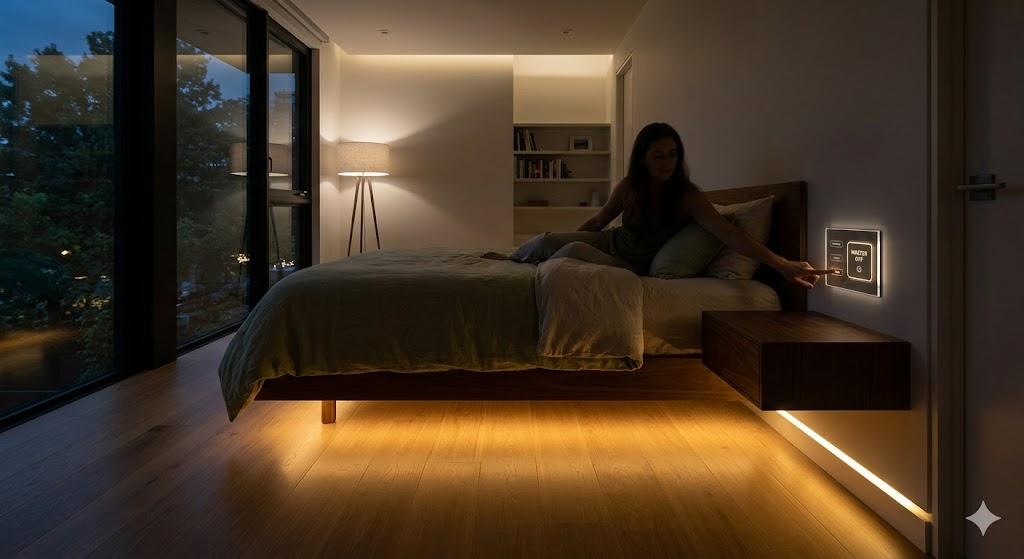
The bedroom is the ultimate circadian zone. The lighting control system should feature a "Master Off" button by the bedside to instantly plunge the home into darkness, and a "Nightpath" mode that softly illuminates the bathroom floor at a dim, ultra-warm 2200k if you wake up at 2:00 AM—ensuring your sleep cycle isn't broken by a harsh glare.
Living & Dining Areas
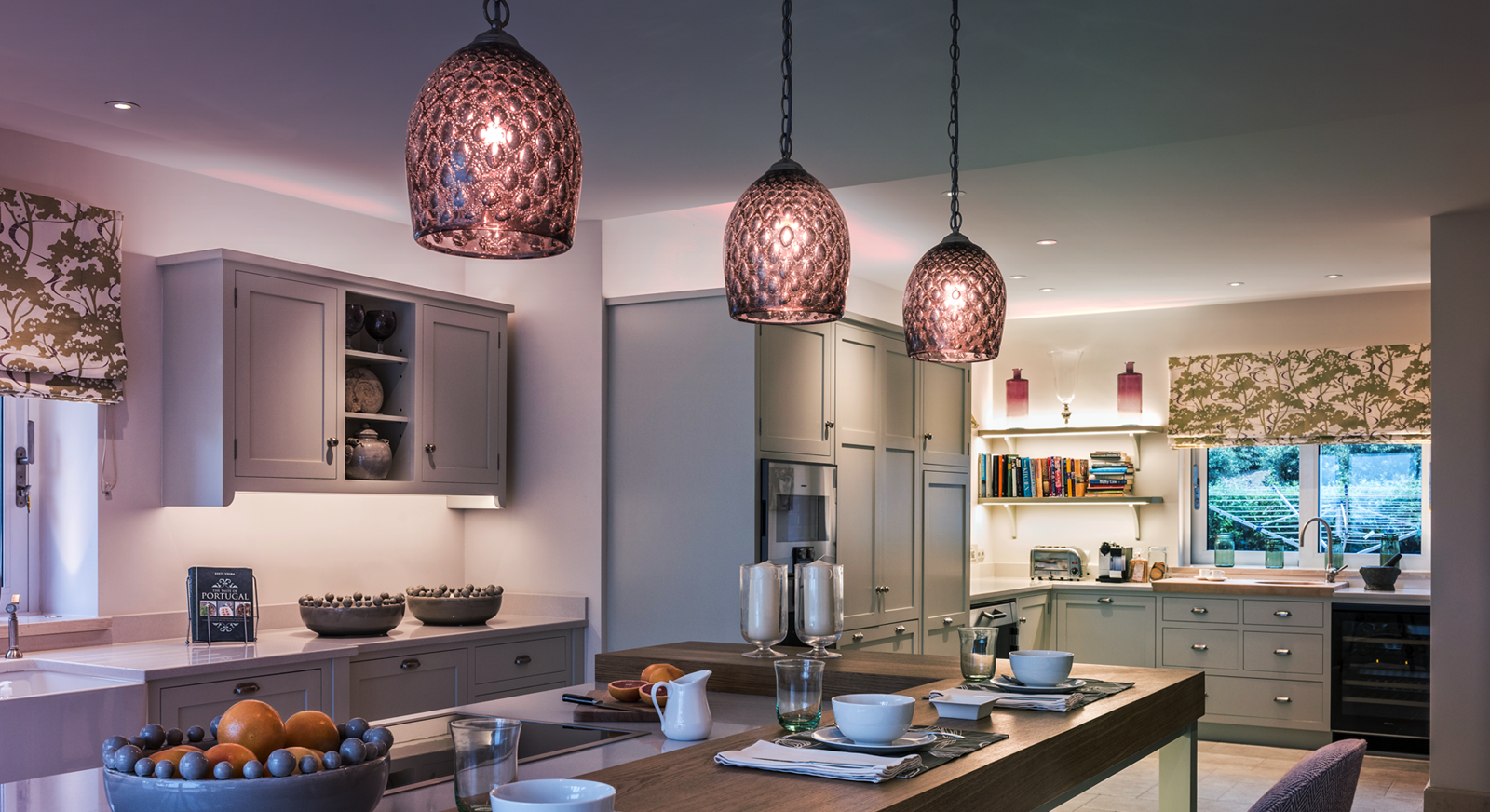
These are dynamic, multi-use spaces. The system should utilize scene-setting to seamlessly transition from bright, vibrant daytime lighting for family activities to deeply dimmed, indirect warm light scenes that encourage intimate conversation and relaxation after dinner.
Bathrooms & Spas
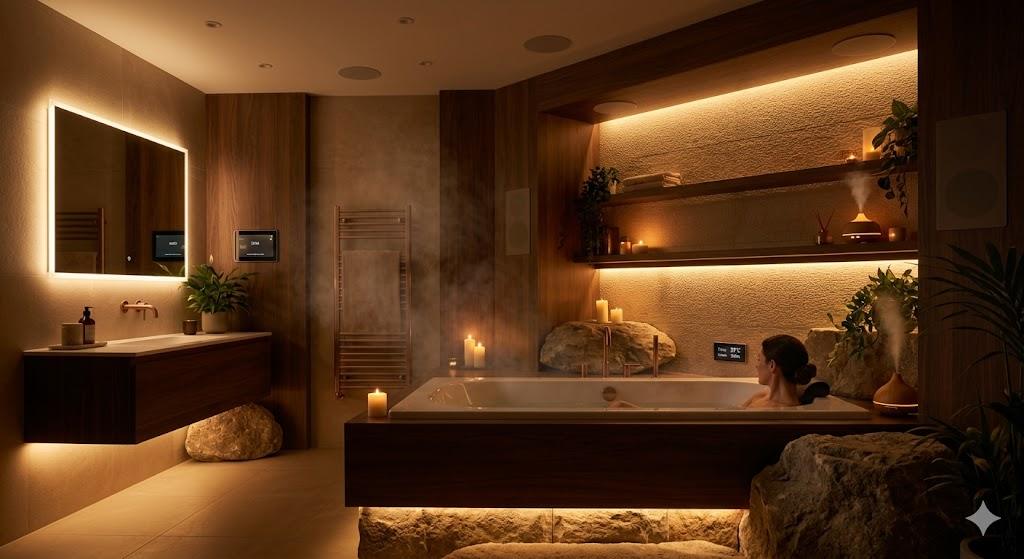
Transform regular bathrooms into wellness sanctuaries. By pairing automated color temperature control with integrated audio and climate systems, a single tap can initiate a "Soak" scene—dropping the overhead lights, warming up the room, and shifting ambient fixtures to a candlelight glow.
Planning a Lighting control System?
Wired or wireless control?
As we start getting you familiar on wired or wireless Automation, we would like you to decide on the light dimming options - phase cut, analogue or DALI protocol.
Latest is the DALI lighting dimming as this is digital and recommended for large houses.
DALI lighting control protocol also offers now color temperature control meaning you can move from 2500 color temperature to 6500 color temperature , moving from warm white to yellow, for more information.
kindly visit endo-lighting.com
Lighting control can be wired or wireless depending on the wiring of your house, there are rumors and talks that wireless lighting control is not as good as wired but that’s just a myth, current automation system gives tough competition to wired home automation system when it comes to lighting automation.
Technologies working on wireless control are Z-WAVE, RF, Zigbee, with our experience in this field, wired automation does not gives you a flexibility of scale ability when it comes to increase in the number of circuits or modules.
Even for that matter in case you want to add a new lamp in your living room and if you have used the wired automation and not planned a wire at that location, that lamp cannot be automated but this restriction is not faced with wireless brands.
We have moved away from data cables to wifi networks wherein we transfer data or stream movies in Gigabytes and for automation the data transferred is in Mbps so why not wireless option with the freedom of scale ability.
Wired automation on the other hand gives more flexibility in terms of choosing the control panels and work on open protocol like KNX which today is used by over 350 brands across the word and to name the few big names are Schnieder, ABB, Berker from Hager, JUNG, Ekinex and list continues.
Brands we cater to
– Lutron, Crestron, Rakocontrols, Fibaro, Berker-KNX Based, Schneider, Berker, Control4
Control Keypad Options on KNX - Lithoss, Basalte, Berker, Ekinex, Schneider
How do one plan for lighting control automation?
Planning would require to understand how to calculate the lighting circuits, a dimmer channel is needed for each group of lighting that needs to be controlled separately.
Priority Wise :
Experience in our automation installations tells us that client first need to cover the public areas like – Hallways, Dining, Living rooms on automation .
Hallways are often statement rooms and have lighting that benefits from intelligent control. They do however also have a requirement for two way control of stairwells and landings. Many users are familiar with the traditional two way switching concept.
When planning a Hall/Stairwell area it is worth thinking about how the different floors are to be controlled, both separately and together
Give some priority to rooms, everyone has their own opinions on which are key rooms. Whilst dimming in a master bedroom is desirable, if nothing else to avoid the harsh glare of light first thing in the morning, guest bedrooms may come further down the pecking order.
Bath and shower rooms may be more appealing under subdued lighting but even more so if they're used at night, again when a harsh glare is unpleasant.
Are bathrooms often used for baths when a relaxing soak might be enjoyed more in softer lighting? For a true whole house control of course all the rooms should be controlled by the system and its nice to have, for example a 'Master Off' button by the bedside to be sure all lighting is off but a complete system is potentially expensive.
Even within a scene-set room some circuits may benefit from separate control for instance bedside lighting. As with the previous example above if the bedside lights are integrated into the normal room scenes the possible combinations of ambient room settings multiplied by the his/her on/off scenarios, let alone with dim level options, can be considerable.
Instead, possibly think of either having a separate, normal switch for these, or a separate button, or buttons (for dimming) on a control plate.
There are solutions for these issues but they are best discussed before buying a system rather than trying to configure unsuitable parts after the event.
Think about where wall panels should be located and what they should control. Generally a wall-plate should be controlling scenes within the room itself.
Depending on the scope of the system one control panel can be programmed to control different rooms but this can rapidly make the system confusing to use and often clients' wishes have unforeseen contradictions that make programming difficult or impossible.
Consider what other controls may be required, such as 'holiday mode' to simulate occupancy. Interfacing to security systems so that lights come on as well as an alarm sounding. Is control from a smartphone or tablet required?
If the system is to be integrated with an audio visual system then ask the AV installer for advice, they will have experience with lighting control systems and be able to help.
Finally, remember that at any point we will be happy to help with planning a lighting control system for you.
How Do I get a quote?

Please email us the room wise, floor wise break up of rooms with the number of automation circuits you want to control in each room and we will happy to submit a budgetary quote.
For further help and assistance, pricing information or a quotation email your inquiry to sales@solutiontree.in or call 09958231280

